Alpha School: How Its 2-Hour AI Learning Model Works
By Next Gen Remote Learning editorial team · · For: Parents, students and teachers interested in AI in education
Alpha School is a private school in the United States that says children can cover their core academic subjects in about two hours a day, using AI-powered learning software, and spend the rest of the day on life skills and projects. It has attracted national attention, rapid growth and strong criticism. This guide explains how the model works, what it costs, what supporters and critics say, and which of its ideas any student can use. Facts are as reported up to November 2026; check the school's own website for current details.
What is Alpha School?
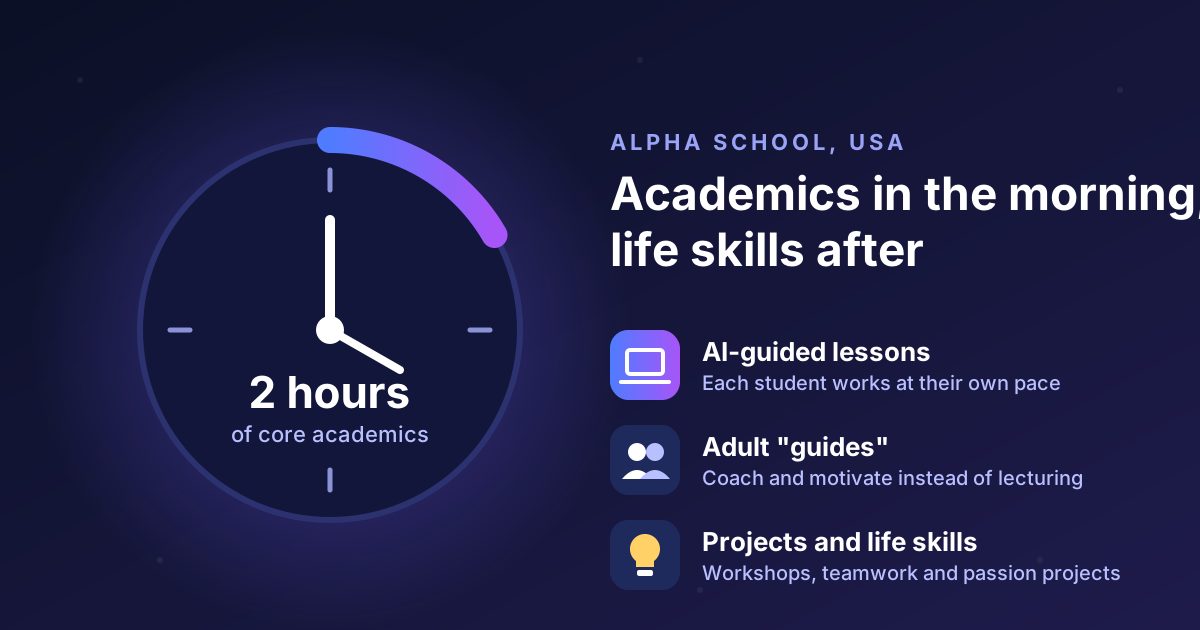
The first Alpha School opened in Austin, Texas, in 2014. Its co-founder, MacKenzie Price, describes the approach as "2 Hour Learning". The Austin campuses cover pre-kindergarten to grade 8 (Alpha School) and grades 9 to 12 (Alpha High).
Alpha is a private, fee-paying school, not a public school. That matters when you read its results, because private schools choose and are chosen by their families.
How a school day works
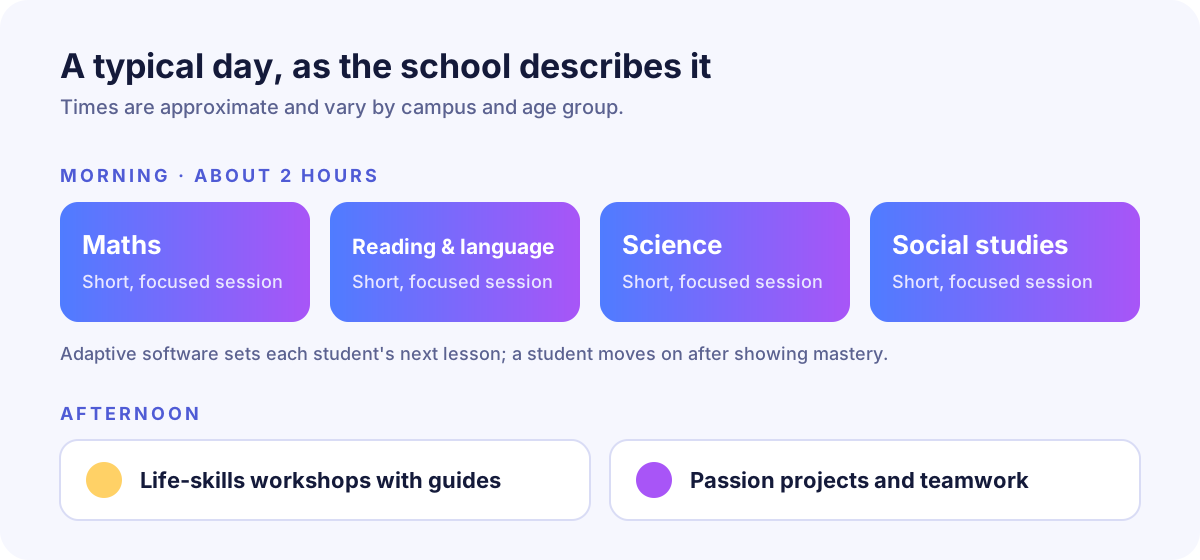
In the morning, students spend about two hours on core subjects: maths, reading and language, science and social studies. Local news reports describe short, focused sessions of around 30 minutes per subject, and the school's own blog describes 25-minute blocks with breaks, a method known as the Pomodoro technique.
Each student works on adaptive software that chooses the next lesson based on what they have already mastered. A student moves on when they show they understand a topic, rather than when the class moves on. This approach is often called mastery learning.
The afternoons are for life-skills workshops, teamwork and passion projects, such as public speaking, financial literacy or building something the student cares about.
Teachers become "guides"
Alpha does not use classroom teachers to deliver lessons in the usual way. Adults called guides supervise the academic sessions, keep students motivated, help when someone is stuck and lead the afternoon workshops. In other words, the software handles much of the direct instruction, and adults focus on coaching.
The school also uses rewards and game-like elements to keep students engaged with their daily goals.
What the school says about results
Alpha says its students learn much faster than in a traditional classroom. MacKenzie Price has said students learn "twice as fast" in only two hours a day, and the school reports test results in the top percentiles nationally on MAP, a widely used standardised test.
What critics say
- Unfair comparisons: critics point out that comparing a private school's scores with national averages, which include all kinds of public schools, does not show the method itself causes the difference.
- Who stays matters: if families who are less happy leave, the remaining students' average can look better than the method really is.
- Little independent evidence: commentators, including a blog from the National Education Policy Center at the University of Colorado, question how the "twice as fast" figure is calculated and call for independent research.
- Teaching to the test: critics argue that strong incentives for test results can encourage practising the test rather than broad learning.
- Cost and access: with tuition in the tens of thousands of dollars, the full model is out of reach for most families.
Alpha has also drawn political attention. CNN reported in January 2026 that the school had the support of the Trump administration, while some education experts and parents remained unconvinced.
How much it costs, and where it is
Tuition varies by campus. A 2025 report on the Scottsdale, Arizona campus listed about $40,000 a year, and Axios reported in August 2026 that tuition across the network ranges from about $45,000 to $75,000 a year. A related lower-cost network, Texas Sports Academy, has been reported at $5,000 to $15,000 a year.
The network is growing quickly. Axios reported plans to grow from about a dozen campuses to roughly 50 in the 2026 school year, in cities across the United States.
What any student can learn from Alpha's ideas
Whether or not the headline claims hold up, several ideas behind the model are well supported by research, and none of them require a $40,000 school:
- Mastery first: move on only when you can do a topic without help. Gaps left behind make later topics harder.
- Short, focused sessions: 25 to 30 minutes of real concentration, with a short break, often beats hours of distracted studying.
- Personal feedback: in a famous 1984 study, the educational researcher Benjamin Bloom found that students taught one-to-one with mastery methods did far better than students in ordinary classes. This is often called the "2 sigma problem".
- A caring adult: software can set the next exercise, but encouragement, accountability and explanations from a person keep students going.
One-to-one online tutoring is one of the most direct ways to get personal feedback and mastery-based teaching at a fraction of the cost: a tutor can find exactly where a student is stuck, set the right next step and keep them accountable.
The bottom line
Alpha School is a bold experiment: AI software for academics, adults as coaches, and afternoons for life skills. Families who have chosen it are often enthusiastic, but the strongest claims have not yet been tested independently, and the cost is very high. The most useful lesson for everyone else is the method underneath: mastery, focus and personal support.
References and further reading
- Alpha School (official website)
- Alpha School blog: How AI and gamification transform learning at Alpha School
- Alpha School, Wikipedia
- FOX 7 Austin: Alpha School uses AI to teach students academics for just two hours a day
- KJZZ (2025): Scottsdale school says kids can learn core skills in AI-powered lessons 2 hours a day, for $40K
- Axios (August 2026): AI-powered Alpha Schools expands to 50 campuses
- Community Impact (2025): Alpha Schools to open Texas Sports Academy locations
- CNN (January 2026): Is AI schooling the future of education, or a risky bet?
- National Education Policy Center (University of Colorado): The price kids pay
- Bloom (1984), The 2 Sigma Problem, Educational Researcher 13(6), 4–16